
“Mortimer, We’re Back!” – Trading Places, 1983
Hopefully everyone had a great summer, but now it is back to school, reality, and the last stretch of the year. 2026 has had many surprises, so we thought it would be useful to just recap the main market driving events of the first half, what happened in August that are relevant, and what investors are watching for year end.
But first, let’s look at where the market stands this year.
| Index Performance | August | Year to Date |
| S&P 500 | 2.7% | 13.1% |
| Nasdaq Composite | 4.0% | 13.9% |
| MSCI ACWI ex US | 2.6% | 17.4% |
| Bloomberg Bond Index | 0.4% | -0.3% |
| Gold | 9.1% | 3.2% |
| PHLX Semiconductors | 2.0% | 62.9% |
Source: ycharts.com
August was a surprisingly strong month with some mixed news. The Iran conflict continued to show little progress towards resolution. The Strait of Hormuz and oil prices remain elevated. The administration renewed tariff spats with Canada. The Committee for a Responsible Federal Budget highlighted that the National Debt surpassed $40 trillion in August.
First Half of the Year: Data Center Build Out and Sticky Inflation
The year started with optimism for equity markets and declining inflation and interest rates.
- Capital Expenditure Build Out for Artificial Intelligence Data Centers: The main driver of markets this year has been the huge CapEx spending on building data centers to support the infrastructure of AI. This CapEx spend by the major technology giants has only grown throughout the year, fueling earnings and markets.
- Sticky Inflation: Inflation was expected to drop during 2026, but inflation did a reversal after the closure of the Strait of Hormuz due to the Iran conflict and continued trade spats. Inflation started the year dropping to 2.4% but then spiked back up as oil prices rose. The chart below shows how inflation shifted over the year.
- Ssource: U.S. Bureau of Labor Statistics, tradingeconomics.com
- Federal Reserve Shifts: The Fed was expected to cut rates this year, but that sentiment shifted as inflation reignited. The market currently expects the Federal Reserve to raise rates on September 15th per the CBOE Fed Watch tool (60% of market participants expect a 25 bps raise).
What Happened in August:
- Corporate Earnings: Earnings remained strong as spending on CapEx projects continued. But political backlash against data centers grew, and there is growing concern about the sustainability of the AI growth wave.
- Jackson Hole: Federal Reserve Chair Kevin Warsh gave a hawkish speech at the annual Jackson Hole conference. The Fed is making more and more noise towards a possible Fed hike, and the market is listening and driving interest rates higher, especially on the longer end of the curve like the 10-year and 30-year treasury bond.
- Global Manufacturing Slowdown: China reported its second Producers Manufacturing Index report that showed the manufacturing sector there in contraction territory for the second straight month (any reading below 50 on the PMI is interpreted as contraction). This underscores a weakness in global demand for goods and is possibly an outcome of global inflation and higher interest rates.
What are Investors Thinking About into Year End?
- AI Hype vs Execution: One of the biggest stories has been the once in a lifetime build out and implementation of Artificial Intelligence. But there are many skeptics ringing the bell of concern, sometimes comparing the massive CapEx spend and investor optimism to the Technology Bubble (and subsequent crash) of 2000.
- Inflation and Interest Rate Path: With the possible increase in interest rates and higher than anticipated inflation, investors remain concerned that interest rates will continue to rise which will reduce growth. It is worth noting that much of the AI CapEX spend is funded with debt, so rising interest rates will make the build out more expensive than it already is.
- Geopolitics: Renewed trade tensions with Canada just go to show that geopolitical concern can come from anywhere. We also have continued mix messaging and confusion around what and when we might expect a resolution of the conflict with Iran.
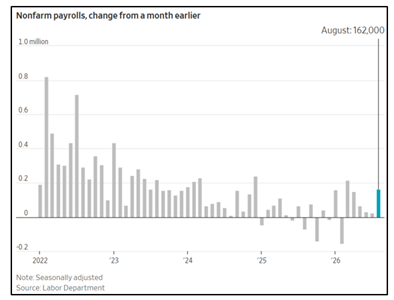
- Employment: We got a positive August job growth report that showed the U.S. added 162,000 jobs were added vs 53,000 expected. In other positive jobs news, previous months were revised higher (June +11,000, July +44,000).
Where does this leave us?
It is a tricky spot right now to try and predict where markets go next. We have midterms coming up and still a lot of unanswered questions. In addition, the market continues to trade near highs and show strong participation across industry (often referred to as breadth) in the rally.
For us, we feel there is a lot of information in the trends. The trend right now shows a stock market in rally mode and interest rates pushing higher. The trend in geopolitics is best described as chaotic. All of this makes us think that the volatility that seemed absent during the summer might come back in full force.
But that can be a good thing for investors. We see volatility as an opportunity: to reposition, to take advantage of great names at great prices, and to add yield in the portfolio. We are big believers that investors should always feel empowered, not victims of ebbs and flows.
Want to know how? Great, let’s jump on a call! This is what we do!!!
Have a great start to the Fall season!
Jordan Kaufman
Chief Investment Officer
Green Ridge Wealth Planning