

When investing, it’s common to think about diversifying within both your overall portfolio and each individual account. While this approach can work, we believe in going a step further and paying close attention to the details. Our CEO, Bobby Mascia, often says, “Diversification is lazy asset management.” What he means is that you shouldn’t diversify just for the sake of it. Instead, be strategic and invest in sectors or assets that are performing well. When market conditions change, you should adjust your investments accordingly. Additionally, consider whether your accounts are optimized to minimize tax impact. Let’s dive deeper into what this means.
Asset Types
- Equities (Stocks or ETFs): If held for more than a year, these are taxed at the long-term capital gains rate when sold which is typically lower than your ordinary income tax rate. (“Ordinary income” is the income you have earned and will be taxed at in your given tax bracket). If held for less than a year, they are taxed at the typically higher short-term capital gains rate.
- Fixed Income (Bonds): The interest earned is taxed at your ordinary income tax rate.
Account Types
- Joint/Individual Accounts: These are taxable accounts, meaning any interest earned or gains realized from selling stocks are taxed in the year they occur.
- IRA: This is a tax-deferred account, meaning there are no tax implications for interest earned or positions sold until you withdraw from the account. Withdrawals are taxed at your ordinary income rate at the time of withdrawal.
- Roth IRA: This is considered a “tax-free” account because contributions are made with money that has already been taxed. Any gains realized or interest earned, as well as withdrawals, are not taxed.
Asset Location Tax Optimization Examples
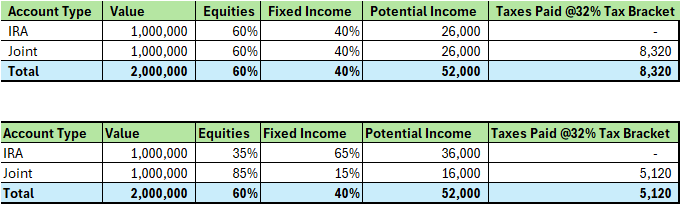
Let’s use simple examples to illustrate the point. Both portfolios below have a value of $2 million, with a standard 60/40 allocation (60% equities, 40% fixed income).
Example 1: In this portfolio, the IRA and the Joint account are allocated the same amount to equities and fixed income (60/40). The joint account produces $26k of annual income, which is taxed at your ordinary income tax rate.
- Say you are in the 32% tax bracket, this would add another $8,320 to your tax bill for the year
Example 2: The joint account has a higher percentage of equities, and the IRA has a higher percentage of fixed income. The overall allocation remains the same (60/40). Here, the joint account produces only $16,000 of annual income.
- Once again, say you are in the 32% tax bracket. Here, you would only add $5,120 to your tax bill for the year, thereby saving a little over $3,000 compared to the first example. This may not seem like much; however, as complexities increase and your income increases, the potential savings also increase.
By thoughtfully considering the taxability of the assets in your portfolio, you can lower your tax burden not just in a single year but over time. In this example, you reduce your taxable income by $10,000 through optimizing the types of accounts and the taxability of the assets. This is done without changing the overall risk or return potential of the entire portfolio.
Key Assumptions
- Assuming a 32% tax bracket
- Equities earn a 1% dividend.
- Fixed income earns 5% interest.
This can get more complex, especially as you dig deeper to learn more about their appreciation or taxable income, but even a basic understanding can be very beneficial. If you have any questions or would like to discuss in more detail, feel free to reach out to us.
The foregoing mention of taxable income is in the appreciation of the portfolio and is not income withdrawn; taxation on that would be different. You are responsible for consulting your own tax advisor as to the tax consequences associated with any investment or option. The tax rules governing options are complex, change frequently and depend on the individual taxpayer’s situation. These are all things to confirm with your tax advisor and should not be deemed as advice.
Summary:
Asset location is the practice of strategically placing assets—such as equities and fixed income—across taxable, tax-deferred, and tax-free accounts to minimize taxes without altering overall portfolio risk or return. Equities, if held long-term, benefit from lower capital gains rates, making them often suitable for taxable accounts, while interest from bonds is taxed as ordinary income, favoring tax-deferred or tax-free accounts. The article demonstrates this with a comparison: maintaining overall 60/40 allocation but shifting more bonds into IRAs reduces taxable income and lowers annual tax liabilities. By reallocating more fixed income into tax-deferred accounts and equities into taxable accounts, investors can save thousands annually without changing investment outcomes. Thoughtful asset location enhances after‑tax returns over time by aligning asset types with account characteristics while preserving diversification.
Disclosure:
Green Ridge Wealth Planning, LLC is a registered investment adviser. The information provided here is for general informational purposes only and should not be considered an individualized recommendation or personalized investment/tax advice. The investment/tax strategies mentioned here may not be suitable for everyone. Each investor needs to review an investment/tax strategy for his or her own particular situation before making any investment decision(s). You are responsible for consulting your own investment and/or tax advisor as to the consequences associated with any investment.
The opinions referenced are as of the date of publication and are subject to change due to changes in the market or economic conditions and may not necessarily come to pass. Any opinions, projections, or forward-looking statements expressed herein are solely those of the AUTHOR, may differ from the views or opinions expressed by other areas of Green Ridge Wealth Planning, LLC, and are only for general informational purposes as of the date indicated.